Lord Dowding Memorial Hangar
This hangar was erected in 1985 as a tribute to Air Chief Marshal Lord Dowding, Commander-in-Chief of Fighter Command during the Battle of Britain, when the country stood alone.
The Lord Dowding Memorial Hangar is more than a collection of aircraft and artefacts.
Every exhibit has a story.
Behind every piece of wreckage is an aircraft.
Behind every aircraft is an airman.
And behind every airman is a human story.
Take your time. Look closely. Read the stories.
Then step into the world of the Battle of Britain.
The Men on the Other Side
Many of the exhibits here tell the stories of the Luftwaffe airmen who flew against Britain in 1940. Among them are:
- the substantial remains of the Bf 109E flown by Oberleutnant Ulrich Steinhilper of JG 52. He baled out and, after the war, came up with the principle of word processing. Had he been shot down and killed, just think how our day-to-day lives might differ!
- wings from the Bf 109Es of Leutnant Erich Meyer (JG 51), Feldwebel Ernst Hempel (JG 53) and Oberleutnant Kurt Dähne (JG 26)
- rare parts from two Junkers Ju 87 ‘Stuka’ dive bombers: a large section of rear fuselage from one shot down at Chidham on 18 August 1940, and a wheel spat from another, shot down on 16 August by Flt Lt Carl Davis, an American flying with the RAF while the USA was still neutral
The One That Got Away
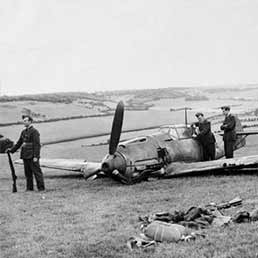
A life-sized diorama shows the crash-landed Bf 109E of Oberleutnant Franz, Baron von Werra, a Knight’s Cross holder and Luftwaffe ace, shot down in September 1940. He became famous as the only German prisoner to escape from Canada, make his way home and return to operational flying. His story became the 1957 film The One That Got Away, starring Hardy Krüger.
The Engines and Their Stories
The hangar holds:
- fifteen Daimler-Benz DB 601 engines recovered from Luftwaffe aircraft, including those from the first and last Bf 109Es to crash on British soil in 1940
- two Jumo 211s from Junkers Ju 88s
- three Bramo-Fafnir engines from Dornier Do 17s
- a BMW 801D radial from a Focke-Wulf Fw 190
- the massive 24-cylinder Napier Sabre from a Hawker Tempest
RAF Pilots Too
Wings from the Spitfires of Flt Lt Ian Gleed of No. 266 Squadron and F/O Robin ‘Bubbles’ Waterston of No. 603 Squadron remember the airmen who flew against the Luftwaffe. A display of medals and memorabilia remembers Flt Lt Ian Lewis McGregor Hallam (later Squadron Leader), who flew with Nos. 610, 222 and 73 Squadrons during the Battle of Britain.
A Pioneer in Wartime
A display remembers Amy Johnson CBE, the record-breaking aviator who became the first woman to fly solo from Britain to Australia. She flew into RAF Hawkinge on 9 September 1931, returning from her record-breaking flight to Moscow. In the war she joined the Air Transport Auxiliary, ferrying aircraft for the RAF. On 5 January 1941 the Airspeed Oxford she was flying came down in the Thames Estuary, and she was lost and remains missing to this day. The display includes a piece of that aircraft, along with photographs and documents from her life.
The Aircraft as the Backdrop
- Bf 109E replicas. Three full-sized replicas were made for the 1969 film Battle of Britain. They were built to match the film’s flying ‘Messerschmitts’ – Spanish-built Hispano Buchóns with Rolls-Royce Merlin engines – so the Museum had to rebuild everything from the cockpit forward to restore the true Bf 109E shape. Many original parts have been used in their rebuild.
- A Fieseler Storch, the Museum’s latest arrival, now hanging from the hangar roof. Built in Czechoslovakia for the Luftwaffe, it was captured in Berlin in May 1945 and test-flown by the famous Royal Navy test pilot Captain Eric ‘Winkle’ Brown. It has the distinction of being the only Luftwaffe aircraft ever to land on a Royal Navy aircraft carrier.
- A Grunau Baby glider, the type on which many Luftwaffe pilots first learned to fly before the war.
- A Fokker Triplane and the fuselage of a Gotha bomber, from the First World War film Flyboys.
- A Link Trainer, used extensively to teach pilots instrument or ‘blind’ flying, in which trainees learned to fly the aircraft by relying solely on their instruments.
Ground Defences
Exhibits on Britain’s defences include:
- a 3.7-inch anti-aircraft gun, a 40mm Bofors gun and two searchlights
- three types of wartime air-raid shelter: Anderson, Morrison and Consol
- lengths of British pipe mines recovered from Hawkinge airfield in 1999
- German bombs of the kinds dropped on Hawkinge and across Great Britain during the Battle of Britain
- a diorama of the hangar line at RAF Hawkinge, including the ground where the Museum now stands
The Home Front
The former Link Trainer building next door houses some of the Museum’s large Home Front collection from the Battle of Britain period. It includes toys and money of the time, and uniforms of the police, firemen and firewomen, and the Home Guard. The uniforms of the Women’s Voluntary Service and the Women’s Land Army recall two of the vital roles women played in the war.
Every display is backed by detailed research and photographs, to tell the personal story behind each exhibit.
