Stuart-Buttle Hangar
The Stuart-Buttle Hangar is the Museum’s largest building and is dedicated to the memory of Squadron Leader Stuart-Buttle, an RFC and RAF fighter pilot of the First World War. Opened in 1995, it was made possible in large part through the generous support of his widow, Mrs A. Stuart-Buttle.
The Museum focuses on the airmen, aircraft and experiences of the Battle of Britain, and the men who fought in the skies over Britain in 1940. In 2026 the Museum’s volunteers added a section on the air war in the Battle of France and the lead-up to the Battle of Britain.
At the heart of the collection are the airmen themselves. Aircraft, engines, wreckage, photographs and personal possessions provide a tangible connection to the pilots and aircrew who flew, fought, survived and, in many cases, lost their lives.
The Battle of Britain
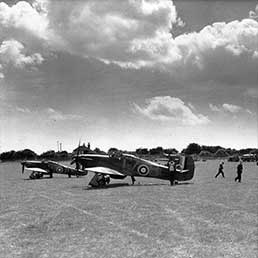
The Battle of Britain is the principal theme of the hangar. Among its most recognisable exhibits are full-size Hurricane and Spitfire replicas built for the 1969 film The Battle of Britain, much of which was filmed at Hawkinge. The Museum has preserved and restored a number of these rare film aircraft.
The collection also includes a full-size Boulton Paul Defiant replica, a wooden replica of the prototype Spitfire K5054, which has flown, and original training aircraft including a de Havilland Tiger Moth, Miles Magister and North American Harvard. The hangar is also home to the Museum’s ongoing Westland Whirlwind Project, supported by rare Whirlwind artefacts, including the only two known surviving Rolls-Royce Peregrine engines.
A particularly significant part of the collection is the 21 recovered Rolls-Royce Merlin engines. Representing aircraft lost during the Battle of France and the Battle of Britain, this is set to be the largest collection of recovered Merlin engines on display in the world. Backed by detailed research, each engine is displayed alongside the story of the aircraft and airmen it was associated with, providing a direct link between the surviving artefact and the individual behind it.
The hangar also reflects the international character of the Battle of Britain, and the many nationalities who served alongside the RAF during the summer of 1940. Among those represented are Flt Lt Alan Deere of New Zealand, Captain Albert van den Hove d’Ertsenrijck of Belgium, F/O Franciszek Gruska of Poland and Sgt Josef Koukal of Czechoslovakia.
Personal artefacts, photographs and memorabilia help bring their individual stories to life, while illustrating the contribution made by airmen from across Europe and the Commonwealth, as well as volunteers from neutral Ireland and the United States.
The Battle of France
The collection also includes an important group of artefacts relating to the Battle of France of 1940, an earlier chapter in the air war that preceded the Battle of Britain.
Among these are recovered components from Hurricane, Dewoitine D.520, Curtiss Hawk 75, Fairey Battle and Dornier Do 17 aircraft. Together, these artefacts provide a tangible connection to the aircraft and airmen involved in the fighting over France, and help place the Battle of Britain within the wider air war of 1940.
Throughout the Stuart-Buttle Hangar, the aircraft and artefacts provide the evidence, but the airmen are the story. The collection brings together the machines they flew, the equipment that supported them and the objects they left behind, to create a lasting tribute to those who fought in the Battle of Britain and the wider air war of 1940.
Vehicles
On display in the hangar is a collection of period vehicles typical of those found on an operational RAF Station in 1940. These include a Ford WOT 1 ambulance, Bedford MW water tanker, Austin Tilly light utility vehicle, Beaverette armoured car, RAF Commer Q2 tractor unit and three period fire tenders.
Together, these vehicles illustrate the essential transport, fire-fighting, medical and ground-support services needed to keep a fighter station operational during the Battle of Britain.
