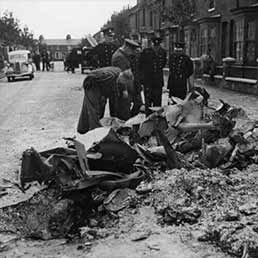
Operations Block
Where the Battle Was Recorded
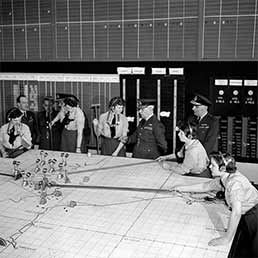
Built in 1927, the Operations Block was the nerve centre from which flying operations at RAF Hawkinge were controlled during the Second World War.
Today, it houses one of the Museum’s most remarkable collections: artefacts recovered from more than 700 Battle of Britain aircraft.
Most were excavated by the Museum’s own recovery team during the late 1960s, 1970s and 1980s. Others have been donated over the years by other ‘aircraft diggers’ who wanted these pieces of history preserved for future generations.
From complete aero engines to tiny strips of alloy stamped with an aircraft’s identification number, every object has a story to tell.
Most bear the scars of the violent impact that brought an aircraft – and often its pilot – to the ground more than 85 years ago.
Every Fragment Tells a Story
The recovery of an aircraft is only the beginning of this story.
After each excavation, the circumstances of the crash are researched in detail. The recovered material is then cleaned, catalogued and displayed.
A letter.
A control column.
An engine.
A flight instrument.
A handful of twisted fragments.
Even a few empty cartridge cases.
Each can unlock the story of an individual aircraft and the people who flew it.
As you move through the Operations Block, the displays begin to form a much larger picture. Each is another piece of the jigsaw – bringing together first-hand accounts, photographs, documents and tangible relics to reveal the human story of the Battle of Britain.
For some of the men represented here, these artefacts may be the only surviving memorial to their lives beyond a gravestone.
For others, tragically, there is not even a known grave.
The Battle Comes Full Circle
The stories in these displays often cross paths in extraordinary ways.
You may see the remains of an aircraft shot down by one pilot – and later discover the wreckage of an aircraft in which that same pilot was himself shot down.
Some survived to fight another day.
Others did not.
Some pilots were shot down and killed on their first combat sortie. Others had already experienced combat in the Spanish Civil War, in Poland, the Low Countries or France before reaching Britain in 1940.
Some survived being shot down five or six times. There were even two Allied pilots who were shot down twice in a single day.
Together, their stories reveal just how brutal and unpredictable aerial combat could be.
A Battle Fought by Many Nations
The Battle of Britain was not fought by British and German airmen alone.
Represented in the Museum’s collection are airmen from Australia, Belgium, Canada, Czechoslovakia, France, New Zealand, Poland, South Africa and the United States, as well as Britain and Germany.
Each brought his own journey to the battle – and each became part of the extraordinary international story of 1940.
The Americans Who Came to Britain’s Aid
In 1940, the United States was still neutral.
Yet a small group of young Americans believed that Britain needed their help and crossed the Atlantic to volunteer for the RAF.
American citizens were prohibited by US law from enlisting in the armed forces of countries at war, so some volunteers concealed their nationality or claimed Commonwealth identities in order to enlist.
During the Battle of Britain, nine American pilots flew operationally alongside their RAF comrades.
One of them was John Kenneth Haviland.
Many more Americans followed, eventually forming the famous Eagle Squadrons, which flew with the RAF during 1940–41 before the United States entered the war. A memorial to the American Eagle Squadron can be seen in the Lord Dowding Memorial Hangar.
Haviland’s story is particularly remarkable. He was one of only two American pilots who flew in the Battle of Britain to survive the Second World War.
The Museum was honoured to welcome him as a guest during the 50th anniversary commemorations of the Battle of Britain in 1990.
His story – like so many preserved in the Operations Block – is a reminder that the Battle of Britain was fought not simply between aircraft, but by individuals who had travelled extraordinary distances, taken enormous risks and, in many cases, never returned home.
Look Closely
Nothing in the Operations Block is here by accident.
Every fragment was once part of an aircraft.
Every aircraft had a crew.
Every crew had a story.
Take time to examine the displays and you will begin to see how those individual stories connect – revealing the wider story of the Battle of Britain, one piece at a time.
